How Organizations Can Align Programs with Impact Goals
Organizations that work in social impact, whether NGOs, foundations or corporate CSR teams, often run multiple programs at the same time. Training initiatives, community empowerment activities, grants mentoring programs, and partnerships with local institutions are all common approaches. On the surfaces, these effort can look productive and meaningful.
Yet over time, many organizations start asking a difficult question: Are all of these programs actually contributing to the change we want to see?
A program may run smoothly from an operational perspective, but if does not clearly contribute to the broader impact goals of the organization, its long-term value becomes uncertain. Alignment between programs and impact goals is what transforms a collection of activities into coherent strategy for change.
The challenge is that alignment rarely happens automatically. It requires deliberate thinking about the relationship between what an organization does on the ground and the outcomes it ultimately hopes to achieve.
When Programs Drift Away from Impact Goals
In many organizations, programs evolve over time in response to opportunities, partnerships, or funding. A new donor might support a specific initiative. A partner organization might propose a collaborative project. Internal teams might develop new ideas to implement.
None of these developments are necessarily problematic. In fact, they often bring valuable resources and innovation. However, as programs accumulate, organizations sometimes find themselves managing a portfolio of activities that no longer clearly connects to their original mission.
The result is subtle but significant. Teams remain busy, stakeholders see visible activity, and annual reports show a long list of initiatives. But when leaders try to explain how these programs collectively lead to meaningful change, the narrative becomes less clear.
This is what happen when programs drift away from impact goals.
Making the Pathway to Impact Visible
Even when organizations have clear impact goals, the pathway from activities to long-term change is not always obvious. Programs operate in complex environments where many factors influence outcomes.
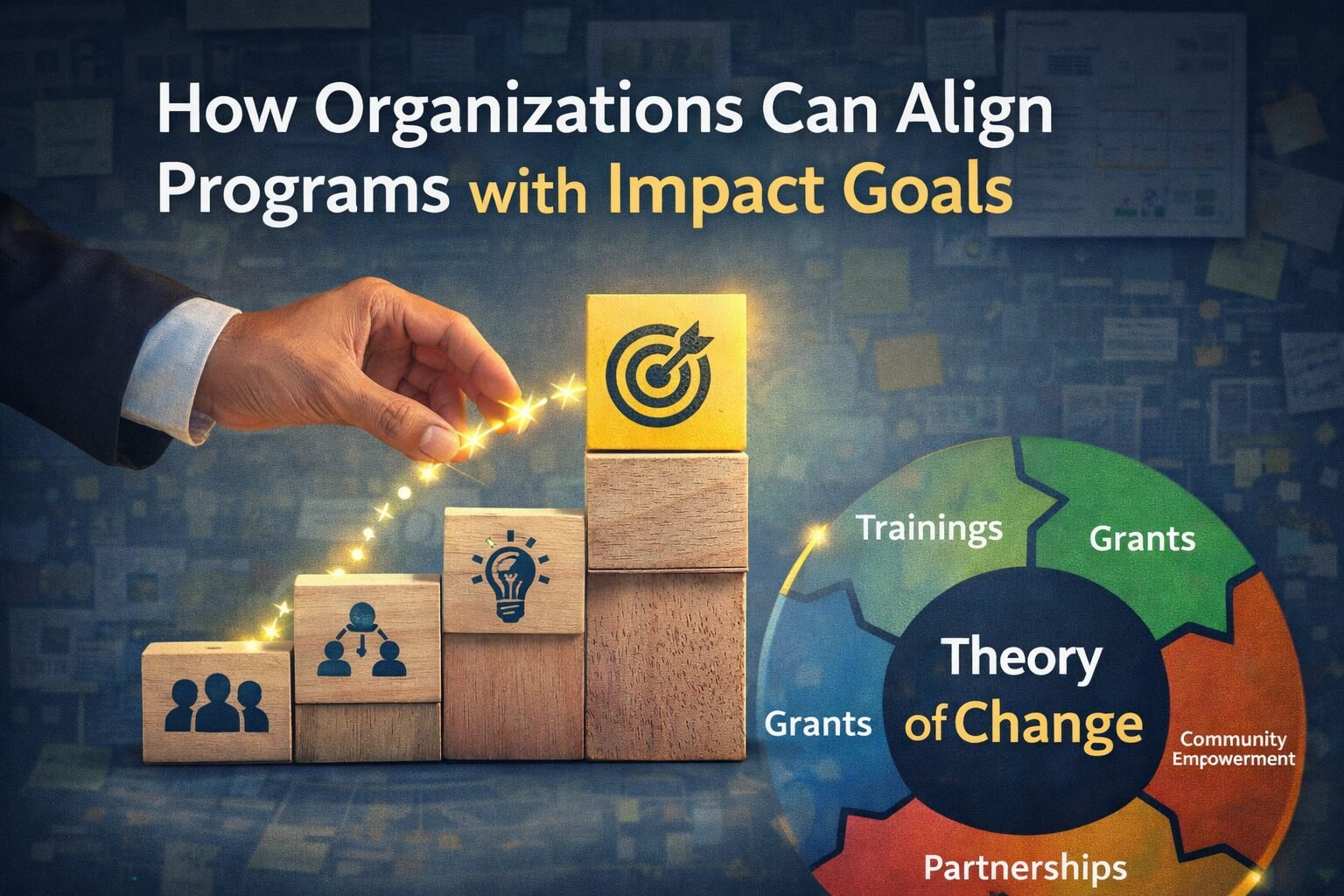
This is why many social impact organizations rely on frameworks that make their assumptions explicit. One widely used approach is the idea of a “pathway to impact,” often articulated through tools like Theory of Change. Rather than listing activities in isolation, this approach maps the sequence of changes that are expected to occur as a result of the program.
By articulating this chain of change, organizations can see more clearly whether their programs logically contribute to their broader impact goals. Activities become part of a larger story about transformation rather than stand-alone interventions.
Moving from Activity to Strategy
When programs are clearly aligned with impact goals, something important happens. Activities stop being isolated efforts and begin to reinforce one another. Over time, this coherence becomes visible not only within the organization but also to partners, funders, and communities.
In this sense, alignment is what transforms program implementation into a true impact strategy. It allows organizations to move beyond simply doing good work toward creating change that is intentional, measurable, and sustainable.